I’ve worked across Serbia’s public finance and social protection ecosystem with UNICEF Serbia, the Ministry of Finance and the Red Cross of Serbia, on how fiscal decisions, the climate transition and crisis responses land on children. The four strands below sit within one continuing engagement.
What I did
Public finance for children training for Parliament. In partnership with the Ministry of Finance, I’ve led the development of a Public Finance for Children training manual for members of the Serbian Parliament. The intent is practical: equip MPs to read the budget cycle with child wellbeing as a load-bearing input, not an after-the-fact line. The manual adapts global PFM frameworks to the structure of Serbia’s budget law and parliamentary scrutiny process.
Energy poverty and municipal public finance. I led a public finance assessment of municipal capacities to finance climate-related public works and child-focused investments, with attention to energy efficiency in poor households. Serbian households spend a substantially larger share of income on food and energy than the EU average, and energy-poor households face a compounding cost: high recurrent bills, low investment capacity, and limited municipal fiscal space to co-finance retrofits. The assessment maps where municipal own-source revenue, central transfers and donor financing can plausibly meet, and where the financing gap is structural.
Price caps and child poverty. In September 2025 UNICEF Serbia published Potential Impact of Serbia’s New Economic Measures on Poverty and Children, an analytical brief I authored on the Government’s anti-crisis package: price caps on around 3,000 essential goods (capping retail margins at 20%, down from an industry average of roughly 40%), financial relief on household credit, and consumer protection changes. The brief sets out short-, medium- and long-term scenarios for poverty in general and for child and family poverty in particular, drawing on global evidence on price-control measures and on the structure of Serbian household spending (food alone is 36.6% of household budgets, more than double the EU average of 17%).
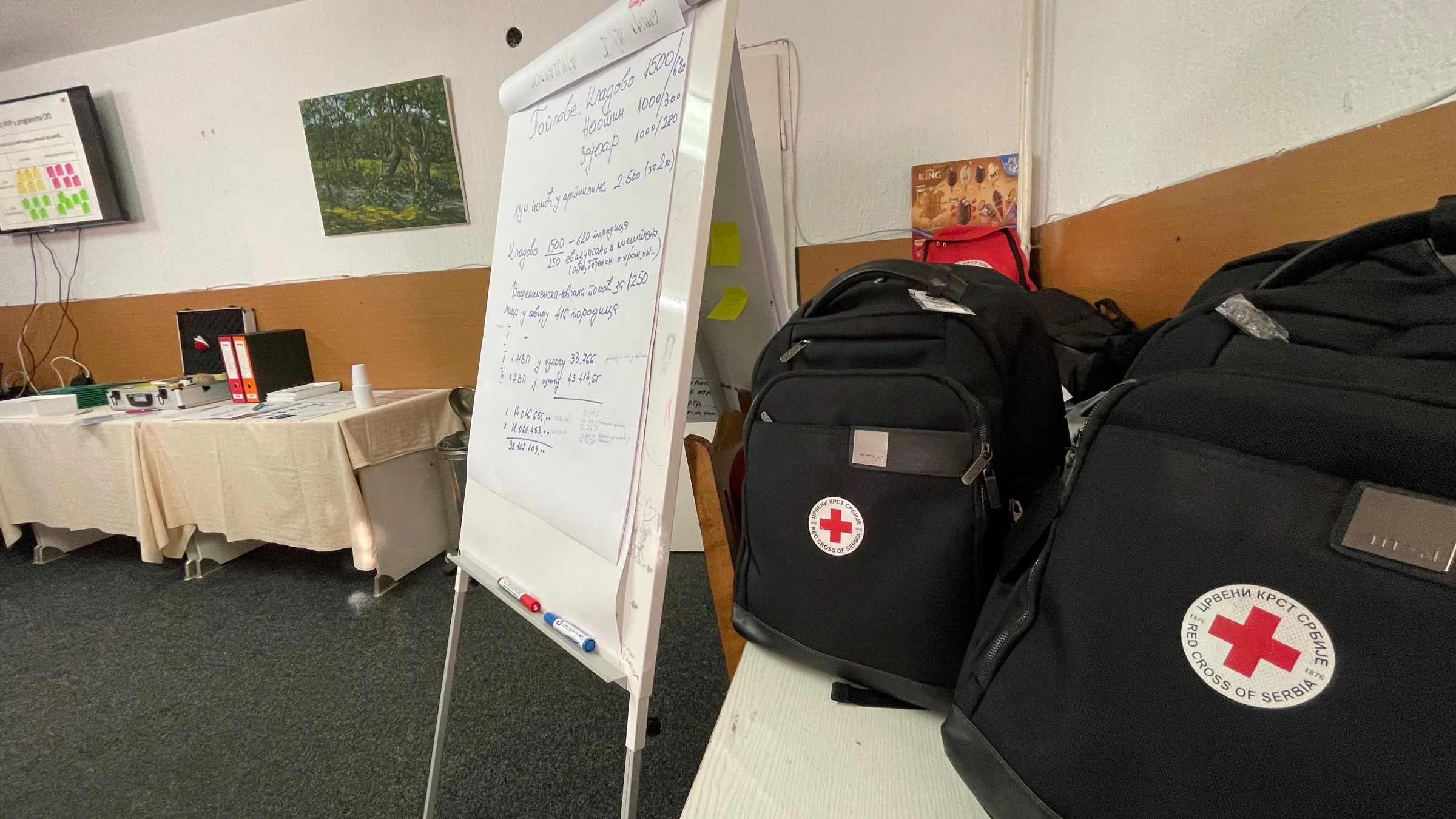
Humanitarian cash with the Red Cross of Serbia. With the Red Cross of Serbia I’ve worked on humanitarian cash assistance and on engagement with their youth volunteer network around energy-poor households. The starting position is unusual: a strong national civil society auxiliary with deep field reach, working alongside (rather than instead of) public systems. The work is about translating that reach into something operationally usable for routine and crisis response, including the handoff points with municipal social services.
Outcomes
The portfolio is ongoing. To date: a published distributional brief on the 2025 economic measures (UNICEF Serbia, September 2025), a Public Finance for Children training manual for Parliament in development with the Ministry of Finance, and a municipal-level financing diagnostic on the climate-and-children intersection. Alongside the headline strands I’ve also contributed to a Human Capital Review with UNICEF and the World Bank focused on social protection for children, and to financial impact analyses with European academic institutions on how the war in Ukraine and COVID-19 have affected Serbian children.